U.S Federal Level
A Deeper Look at the Controversies Surrounding Kristi Noem’s Tenure at DHS
As I posted on Facebook previously, this administration often feels like it is being run in a style similar to the WWE. In professional wrestling there are characters and storylines that constantly evolve. One of the most important characters is the “heel”—the villain whose job is to attract criticism, create conflict, and keep the audience focused on the storyline.
Over the past year, Kristi Noem has effectively filled that role for the administration. For a variety of reasons, she became the central figure drawing public attention, controversy, and political heat. In wrestling terms, every storyline eventually reaches the end of its run. When that happens, the character exits center stage and another one steps forward to keep the narrative moving.
That appears to be what is happening now. With Noem’s tenure ending as the “Top Heel”. The administration will inevitably shift its focus to other figures who will take on a similar role in the political narrative.
Two individuals who could emerge as the next central “Top Heel” are Pam Bondi, the Attorney General, and Pete Hegseth, the Secretary of Defense. Both hold highly visible positions and are closely tied to some of the administration’s most controversial policy areas.
Below is the broader context behind Noem’s departure and the controversies that surrounded her tenure.
Over the past year, the tenure of Kristi Noem as Secretary of Homeland Security became one of the most controversial leadership periods the department has experienced in recent memory. While every administration faces criticism, the accumulation of political, operational, and ethical controversies surrounding Noem created a sustained crisis of confidence that ultimately led to her removal.
One of the most explosive issues involved federal immigration enforcement operations. During a large-scale enforcement initiative in Minneapolis, federal personnel from immigration and border agencies were involved in two fatal shootings. The deaths immediately sparked protests and widespread public scrutiny. Critics argued that the operation demonstrated an aggressive escalation in immigration enforcement tactics in urban areas far from the southern border. Noem publicly defended the federal agents involved, characterizing one of the individuals killed as a “domestic terrorist,” a claim that was quickly challenged by community leaders and some lawmakers. The conflicting narratives surrounding the incident deepened public mistrust and intensified calls for accountability.
At the same time, broader immigration policies implemented during her tenure generated strong political reaction. Expanded deportation efforts and the revocation of temporary protections for certain migrant populations placed the department at the center of a national debate over immigration enforcement priorities. Supporters of the policy argued it represented a long-overdue restoration of immigration law enforcement. Critics countered that the measures were politically motivated and poorly implemented, creating unnecessary humanitarian and diplomatic tensions.
Financial decisions within DHS became another major flashpoint. Congressional investigators focused on a $220 million taxpayer-funded advertising campaign promoting deportation enforcement. The advertisements prominently featured Noem herself and were connected to a political consulting firm associated with her past campaign work. Members of Congress questioned whether the campaign represented appropriate public communication or whether it blurred the line between government messaging and political promotion.
During testimony, Noem stated that the campaign had been approved by Donald Trump. When that claim was later publicly disputed, it added another layer of controversy and raised questions about transparency and internal decision-making within the administration.
The department also faced scrutiny over aviation procurement decisions. Reports indicated DHS had pursued the acquisition of expensive aircraft, including Gulfstream jets and several Boeing 737s, for agency use. Internal officials reportedly warned that chartering aircraft for deportation flights would likely be far less expensive than purchasing and maintaining an entire fleet. Critics described the effort as “jet shopping,” arguing it reflected poor fiscal judgment at a time when DHS already faced budget pressures across multiple operational areas.
Questions about internal leadership dynamics also surfaced during congressional hearings. Lawmakers raised concerns about the role of longtime political operative Corey Lewandowski, who had been working within DHS as a special government employee. Some members of Congress questioned whether Lewandowski’s influence within the department was appropriate given his political background and lack of traditional national security experience. Those concerns added to broader narratives about politicization within the agency.
Finally, Noem’s national image continued to be shaped by backlash from her memoir, No Going Back. In the book, she described killing her dog after a hunting incident and also shooting a goat. The story produced an unusually bipartisan wave of criticism and quickly became a defining controversy that opponents repeatedly referenced during hearings and public debates. While unrelated to DHS policy, the episode significantly affected public perception of her leadership.
Individually, any one of these controversies might have been survivable. Taken together, however, they created a cumulative pattern of political distraction, policy disputes, and leadership questions that increasingly overshadowed the department’s core mission. By the time the administration moved to replace her, the decision appeared less like a sudden development and more like the inevitable conclusion of a long and escalating series of controversies.
In Washington, leadership changes are rarely about a single event. More often they are the result of a narrative that builds over time. In the case of Kristi Noem’s tenure at the Department of Homeland Security, that narrative ultimately became impossible to ignore.
I support Uncapping the house
Uncapping the House refers to a proposed reform to increase the number of seats in the U.S. House of Representatives beyond its current fixed limit of 435 members.
History
The House size was capped at 435 by the Permanent Apportionment Act of 1929, following disputes over urban vs. rural representation after the 1920 census. Before that, Congress had gradually expanded seats with population growth, but gridlock led to the permanent freeze.
Current Issue
Today, each representative serves about 760,000 people on average, diluting individual voter influence compared to the Founders’ vision of the House as the “people’s house.” Proponents argue this favors lobbyists and donors over average citizens.
Proposed Solution
Advocates, like the No Cap Fund, push the “Wyoming Rule,” which would base seats on the smallest state’s population (around 580,000 per district), potentially expanding to 574 seats. This could improve responsiveness without a constitutional amendment, though Congress must approve changes post-census.
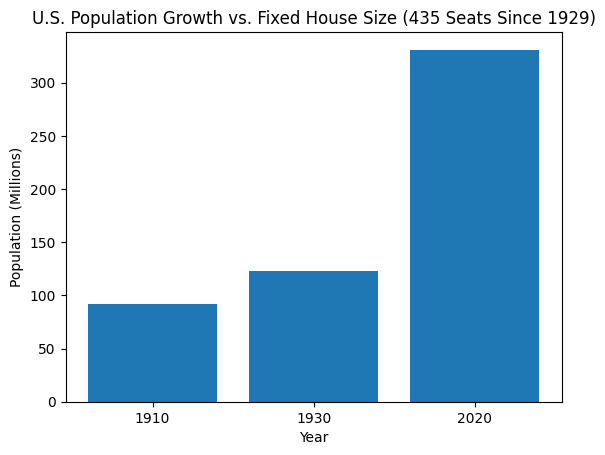
This bar graph shows how dramatically the U.S. population has grown while the House has remained fixed at 435 seats since 1929.
Opinion: Foreign Bombs, Domestic Silence
Let’s be honest about what just happened.
In the days before the bombing of Iran, the national conversation was not about foreign policy. It was about affordability. It was about families struggling with rising costs. It was about public frustration. And it was about renewed scrutiny surrounding the Epstein files — documents that many Americans believe deserve full transparency.
Then, suddenly, the headlines shifted.
Overnight, the news cycle pivoted from grocery bills and unanswered questions to missile strikes and regional escalation. Wall-to-wall coverage. Breaking news banners. National security briefings. The domestic debate disappeared.
This was by design not by coincidence: attention has moved. History has shown that foreign conflict has a way of unifying public focus and drowning out inconvenient domestic narratives. When bombs fall overseas, cameras follow.
That does not mean military action is never justified. But it does mean we should ask hard questions about timing, transparency, and priorities. A nation can care about national security and still demand accountability at home.
If we cannot walk and chew gum at the same time — defend our interests abroad while confronting economic pain and unanswered questions at home — then we are not governing responsibly.
Foreign policy should never become a substitute for domestic accountability.
Introduction to ACE 2032
Today, I am proud to introduce the framework for the American Capitalist Economy (ACE) 2032 — a forward-looking plan designed to strengthen families, expand opportunity, and modernize our economic foundation while preserving the core principles that built this nation.
ACE 2032 is rooted in free enterprise, individual responsibility, and strong communities. It recognizes that capitalism must evolve to meet modern challenges while protecting the foundation of American prosperity: the family, the worker, and the entrepreneur.
Over the coming weeks, I will release one pillar at a time, allowing for transparency, discussion, and refinement. This will not be a top-down mandate — it will be an open blueprint.
American Capitalist Economy (ACE) 2032: A Modern Market Framework
Executive Summary
ACE 2032 proposes a modernization of the United States economic system by strengthening public protections while preserving free-market principles. The goal is not to replace capitalism, but to update it for the 21st century. This model draws inspiration from successful mixed economies found in many democratic nations, including members of the European Union. The framework maintains private enterprise, competition, and entrepreneurship, while establishing universal baseline standards for essential services such as healthcare access, family leave, workforce training, and education affordability.
The United States is a market-based democracy that already includes public institutions such as public education, Medicare, and national defense. Many advanced democracies combine market economies with structured public programs to ensure stability and opportunity. Countries such as Germany and Sweden operate under models that balance economic growth with broad access to essential services.
ACE 2032 builds on the American tradition of innovation while expanding stability and long-term opportunity.
Policy Pillars
1. Universal Healthcare Baseline
Establish a national framework guaranteeing access to essential medical services, while allowing private insurance to operate alongside public coverage.
2. Enhanced Labor Standards
Maintain market flexibility while ensuring strong workplace protections and fair dispute resolution processes.
3. Paid Family Leave
Create a federally supported paid parental leave program funded through payroll contributions.
4. Workforce Development Expansion
Invest in apprenticeships, technical education, and job training programs aligned with emerging industries.
5. Public Education Support
Strengthen partnerships to reduce tuition costs at public colleges and expand career pathways.
1. Universal Healthcare Baseline
Tier I
A Pro-Family, Pro-Market Health Security Framework
Under ACE 2032, healthcare is not treated as a government takeover issue or a corporate windfall system. It is treated as economic infrastructure that stabilizes the American family.
Healthcare insecurity weakens:
* Household savings
* Small business formation
* Workforce mobility
* Birth rates
* Multigenerational stability
Core Principle Under ACE 2032
A strong capitalist economy requires financially stable families.
Medical bankruptcy and untreated illness destabilize the foundation of the nation.
Tier 1 becomes a National Family Health Floor, not a replacement for private markets.
Structure Within ACE 2032
Federal Floor, Market Above
* The federal government guarantees essential services (primary care, emergency stabilization, chronic disease management).
* Private insurers compete above the baseline.
* Employers continue offering expanded plans.
* Innovation and choice remain intact.
This protects capitalism while correcting market failures that hurt families.
Economic Alignment With ACE 2032
A. Small Business Protection
Under ACE 2032:
* Small businesses are no longer crushed by unpredictable health insurance costs.
* The baseline absorbs catastrophic risk.
* Entrepreneurs can leave corporate jobs without losing healthcare security.
This directly supports family-owned businesses and upward mobility.
B. Workforce Stability
Healthy workers mean:
* Higher productivity
* Lower absenteeism
* Fewer disability exits
* Longer workforce participation
ACE 2032 views healthcare as workforce investment, not entitlement expansion.
Medical Bankruptcy Elimination Goal
Medical debt is one of the largest destabilizers of middle-class families.
Tier 1 under ACE 2032:
* Caps out-of-pocket exposure based on income
* Eliminates bankruptcy caused by emergency medical events
* Preserves home ownership and retirement savings
This strengthens intergenerational wealth — a core ACE 2032 objective.
Funding Philosophy Under ACE 2032
Instead of expanding bureaucracy:
* Consolidate inefficiencies in Medicaid and ACA subsidy systems
* Negotiate essential drug pricing nationally
* Cap administrative overhead
* Introduce transparency mandates
The goal: discipline spending while guaranteeing access.
ACE 2032 is fiscally structured, not open-ended.
Political Framing Within ACE 2032
This is not:
* Single-payer
* Corporate-first insurance dominance
* Charity-based patchwork
This is:
* Pro-family
* Pro-market
* Pro-work
* Anti-bankruptcy
* Pro-entrepreneurship
It protects the bottom tier of risk while allowing competition at higher tiers.
Long-Term Outcome Vision (2032–2045)
If implemented correctly:
* Stronger birth rates due to reduced financial fear
* Increased small business formation
* More labor mobility
* Reduced emergency room overuse
* Stabilized rural hospitals
Healthcare becomes part of the economic framework that preserves the American family, not a partisan battlefield.
Tier 2: Competitive Private Expansion
Purpose
Tier 2 allows individuals, families, unions, and employers to purchase enhanced coverage beyond the essential baseline.
This preserves:
* Consumer choice
* Employer-sponsored insurance
* Private sector competition
* Innovation incentives
Tier 1 guarantees access.
Tier 2 guarantees differentiation and competition.
I. What Tier 2 Covers
Tier 2 plans can offer:
* Expanded specialist networks
* Faster access scheduling
* Private hospital rooms
* Expanded mental health sessions
* Dental and vision coverage
* Advanced imaging without referral delays
* Broader prescription formularies
* Elective procedures
Tier 2 is where market competition drives quality and speed.
II. How Tier 2 Fits ACE 2032’s Philosophy
A. Protecting Capitalism
Healthcare becomes a hybrid model:
* Government guarantees essential access.
* Private markets compete on service, innovation, efficiency, and comfort.
This prevents both:
* Full government takeover
* Pure corporate gatekeeping
B. Employer Integration
Employers can:
* Offer Tier 2 wraparound coverage
* Subsidize employee upgrades
* Pool purchasing power for better rates
Small businesses benefit because catastrophic risk is absorbed at Tier 1, reducing volatility in premiums.
C. Individual Freedom
Families can choose:
* Stay at Tier 1 (no one uninsured)
* Upgrade to Tier 2
* Customize based on income and needs
This aligns with your broader ACE 2032 family-first framework:
Security first, choice second.
III. Guardrails
To keep Tier 2 aligned with ACE 2032:
* No denial of coverage for preexisting conditions
* Transparent pricing
* No predatory billing practices
* Clear out-of-pocket disclosure
Competition must serve families, not exploit them.
IV. Strategic Advantage Politically
Tier 2 makes ACE 2032 harder to attack because:
* Conservatives see preserved markets.
* Moderates see fiscal structure.
* Working families see security.
* Businesses see predictability.
It avoids the “Medicare-for-All vs. status quo” trap.
Tier 3: Innovation & Premium Freedom Layer
Purpose
Tier 3 is the fully market-driven, innovation-heavy, premium access tier.
If Tier 1 is the floor,
and Tier 2 is competitive expansion,
Tier 3 is where American medical innovation thrives.
This tier ensures the U.S. remains the global leader in medical advancement while protecting the baseline for everyone.
I. What Tier 3 Includes
Tier 3 allows:
* Concierge medicine memberships
* Executive health programs
* Experimental and cutting-edge treatments
* Expanded elective procedures
* Direct-pay specialty access
* Advanced genomic and precision medicine
* Boutique hospital services
This tier operates largely outside government pricing controls.
II. Why Tier 3 Is Important Under ACE 2032
A. Protects Innovation Capital
The United States leads the world in:
* Biotech startups
* Pharmaceutical research
* Surgical innovation
* Medical device development
Tier 3 allows:
* Private capital to invest freely
* Faster adoption of breakthrough treatments
* High-end competition that drives downstream improvements
Innovation at the top eventually improves care at Tier 1 and Tier 2.
B. Preserves Freedom of Choice
Families who want:
* Expanded autonomy
* Direct physician relationships
* Specialized care environments
May choose Tier 3 without disrupting the baseline guarantee.
This prevents healthcare from becoming uniform and bureaucratic.
C. Economic Multiplier Effect
Tier 3 supports:
* Research hospitals
* Venture capital in biotech
* High-skilled medical employment
* Medical tourism competitiveness
ACE 2032 views healthcare not just as a cost — but as a strategic industry.
III. Guardrails
Even in Tier 3:
* Transparency requirements remain
* No illegal discrimination practices
* Consumer protections enforced
Freedom, but not exploitation.
The Complete ACE 2032 Healthcare Structure
Tier 1 – National Family Health Floor
Guarantees essential care. Prevents bankruptcy. Stabilizes households.
Tier 2 – Competitive Private Expansion
Employer-based and individual upgrades. Market competition on service and speed.
Tier 3 – Innovation & Premium Freedom
High-end care, research acceleration, and medical entrepreneurship.
Strategic Outcome
By 2032 and beyond:
* No American family collapses from medical catastrophe.
* Small businesses are no longer trapped by insurance volatility.
* Private markets remain strong.
* Innovation accelerates instead of stagnates.
* Healthcare becomes aligned with family preservation and economic stability.
This model avoids both extremes:
* Not full nationalization.
* Not pure market chaos.
It is structured capitalism with a family-centered floor.
ACE 2032 Healthcare Spending Projection Model
(All numbers annual, rounded, in trillions unless noted)
Assumed Total National Health Spending Under ACE 2032:
$4.6 trillion annually (stabilized through efficiency reforms)
Tier 1 – National Family Health Floor
Essential universal baseline Funding Source Estimated Contribution% of Tier 1
Federal Government $1.7T 60%
State Governments $500B 18%
Employers (Payroll Share) $400B 14%
Individuals (income-based premiums/copays) $250B 8%
Total Tier 1 $2.85T 100%
Notes:
* Replaces Medicaid + ACA subsidies + portions of Medicare catastrophic coverage.
* Eliminates most uncompensated ER care.
* Caps family out-of-pocket exposure.
Tier 2 – Competitive Private Expansion
Employer & individual upgrade layer Funding Source Estimated Contribution% of Tier 2
Employers (supplemental plans) $700B 55%
Individuals/Families (premium upgrades) $500B 39%
Federal tax expenditure (deduction support) $80B 6%
Total Tier 2 $1.28T 100%
Notes:
* Most current employer-sponsored insurance shifts here.
* Competition drives service quality and speed.
* Small businesses benefit from Tier 1 absorbing catastrophic risk.
Tier 3 – Innovation & Premium Freedom Layer Concierge. Cutting-edge, elective, and experimental Funding Source Estimated Contribution% of Tier 3
High-income households (direct pay) $250B 55%
Private investment & venture capital $100B 22%
Corporate executive health programs $60B 13%
Research partnerships (public-private) $60B 10%
Total Tier 3 $470B 100%
Total System Snapshot
Tier Total Spending
Tier 1 $2.85T
Tier 2 $1.28T
Tier 3 $0.47T
Total $4.6T
Household-Level Projection Example
Middle-Class Family ($110,000 income)
Tier Annual Family Cost
Tier 1 $2,500–$4,000 (income-capped)
Tier 2 (optional upgrade) $3,000–$6,000
Tier 3 Not typical
High-Income Family ($350,000+ income)
Tier Annual Family Cost
Tier 1 ~$9,000 (income-capped)
Tier 2 $8,000–$15,000
Tier 3 (concierge etc.) $20,000+ optional
Fiscal Effect Under ACE 2032
Government Spending
Approx. $2.2T total (federal + state combined)
This is similar to current public healthcare outlays but reorganized with:
* Reduced administrative duplication
* Drug price negotiation
* Bankruptcy reduction savings
* ER overuse reduction
Economic Framing for ACE 2032
Tier 1 = Family Stabilizer
Tier 2 = Market Competition Engine
Tier 3 = Innovation Accelerator
Instead of uncontrolled cost growth, spending is structured by function.
ACE 2032 – Annual Healthcare Cost by Income Level
(Family of Four)
Tier 1 Formula Assumption
* 3%–6% of income (progressive scale)
* Includes premiums + expected copays
* No deductible for preventive care
* Income-based out-of-pocket cap
$50,000 Household Income
Tier Estimated Annual Cost
Tier 1 $1,500 (3%)
Tier 2 (optional) $0–$2,500
Tier 3 Not typical
Total (Tier 1 only) $1,500
Out-of-pocket cap: ~$2,500
$75,000 Household Income
Tier Estimated Annual Cost
Tier 1 $2,625 (3.5%)
Tier 2 (optional) $2,500–$4,000
Tier 3 Rare
Total (Tier 1 only) $2,625
Out-of-pocket cap: ~$4,000
$100,000 Household Income
Tier Estimated Annual Cost
Tier 1 $4,000 (4%)
Tier 2 (optional) $3,000–$6,000
Tier 3 Rare
Total (Tier 1 only) $4,000
Out-of-pocket cap: ~$6,000
$150,000 Household Income
Tier Estimated Annual Cost
Tier 1 $7,500 (5%)
Tier 2 (optional) $5,000–$9,000
Tier 3 Optional concierge $10K+
Total (Tier 1 only) $7,500
Out-of-pocket cap: ~$8,000
$250,000 Household Income
Tier Estimated Annual Cost
Tier 1 $13,750 (5.5%)
Tier 2 (optional) $8,000–$14,000
Tier 3 $15,000–$30,000 optional
Total (Tier 1 only) $13,750
Out-of-pocket cap: ~$10,000
$400,000 Household Income
Tier Estimated Annual Cost
Tier 1 $24,000 (6%)
Tier 2 (optional) $12,000–$20,000
Tier 3 $25,000–$50,000 optional
Total (Tier 1 only) $24,000
Out-of-pocket cap: ~$12,000
What This Model Does
* Protects lower-income families from catastrophic medical collapse.
* Creates predictable caps for middle-class households.
* Preserves market choice at higher tiers.
* Prevents healthcare from exceeding a defined percentage of family income.
Strategic ACE 2032 Framing
Under this model:
* A $50K family pays ~$1,500 instead of facing $15K+ catastrophic risk.
* A $100K family sees predictable, capped exposure.
* Higher-income households support the baseline but retain full upgrade freedom.
* No one is uninsured.
* No one is forced into a single plan.
2. Enhanced Labor Standards:
Balancing Worker Security, Flexibility, and Sustainable Profitability A sustainable and inclusive economy depends on striking the right balance between worker security and employer flexibility. This principle lies at the heart of enhanced labor standards. On one side, workers need reliable wages, safe conditions, and fair treatment to sustain stable livelihoods and a healthy middle class. On the other, employers require the flexibility to adapt to market demands, innovate, and maintain profitability. Achieving both simultaneously is not easy—but it is possible through cooperative governance, modern collective bargaining, and forward‑looking workplace policies that invite unions to play an active, solution‑oriented role.
The Modern Labor Challenge:
The global economy has evolved dramatically in recent decades. Technology, automation, and globalization have reshaped the very idea of work. Companies today need to upgrade operations faster than ever, while workers face uncertainty over job stability and skill relevance. Traditional labor structures, built around lifetime employment and rigid benefits, are under strain. Many policymakers respond to these pressures by prioritizing flexibility—loosening regulations to make hiring and firing easier. Others push for tighter protections, believing stronger enforcement deters exploitation. Yet treating these goals as mutually exclusive misses the real opportunity: design a system where flexibility exists within a framework of fairness. Businesses can thrive in such an environment when employees are secure, motivated, and skilled, and when the rules of engagement are predictable rather than arbitrary.
Unions as Engines of Stability and Innovation:
In this model, unions are not obstacles but strategic partners. Their role extends far beyond traditional wage negotiations. They become co‑architects of adaptive labor policies that strengthen both worker welfare and company performance.
1. Collaborative Bargaining for Flexibility and Security Modern collective agreements can move away from the traditional “zero‑sum” mindset. Instead of fixed work rules that limit employers, unions can negotiate adjustable frameworks that protect workers’ rights while allowing for operational adaptability. For example, a manufacturing firm facing fluctuating demand could bargain for flexible shift rotations or work‑sharing arrangements—avoiding layoffs while reducing downtime costs. By linking flexibility to security (for instance, guaranteeing retraining or recall opportunities after production downturns), both sides preserve their core interests. Companies gain control over costs, and workers maintain continuous engagement with the labor market.
2. Joint Labor–Management Councils Such councils, long established in parts of Northern Europe, can monitor productivity, safety, and training investments on an ongoing basis. These institutions encourage dialogue that prevents friction and builds trust. When labor and management communicate regularly, businesses are less likely to encounter strikes or public confrontations, and workers feel heard in strategic decisions.
3. Profit and Productivity Alignment:
Union agreements can include productivity or profit‑sharing clauses. When employees know they share in success, output quality and efficiency increase. Studies consistently show that shared‑gain models correlate with lower turnover and higher morale, translating directly into stronger profits. Thus, unions can help institutionalize a culture where worker motivation aligns with business performance.
A. Strengthening the Floor:
Essential Protections That Build Confidence Enhanced labor standards require a reliable baseline of rights that makes flexibility sustainable rather than precarious. Workers accept change more easily when they know the essentials—fair wages, safe workplaces, reasonable hours—are guaranteed.
B. Updated Wage and Benefit Models:
Labor and business leaders can co‑design minimum wage systems that reflect local economic realities and productivity levels. Gradual, predictable adjustments reduce shocks to small businesses while protecting purchasing power for workers. Portable benefits systems, negotiated through union involvement, let part‑time or gig workers carry healthcare and retirement credits from one employer to the next—preserving flexibility without sacrificing security.
C. Workplace Health and Safety: Unions traditionally play an oversight role in enforcing safety standards, which benefits employers too. Fewer injuries mean less downtime, lower insurance premiums, and reduced legal risk. Data from OSHA and private industry reports repeatedly show that workplaces with active union participation in safety committees experience fewer costly incidents.
D. Efficient Dispute Resolution: Union representation provides a structured process for handling grievances, preventing escalation into strikes or lawsuits that can paralyze production. Mediation and arbitration—guided by collective agreements—resolve issues faster, saving legal expenses and limiting reputational damage.
4. Investing in Human Capital:
Unions as Partners in Workforce Development Technological advancement demands continuous learning. Here, unions can serve as engines for upskilling and career mobility—functions that simultaneously raise productivity and profitability.
• Joint Training Programs: Unions and employers can co‑fund specialized training centers that prepare workers for new technologies or management roles. In Germany’s dual‑training system, for instance, union‑management cooperation produces a highly skilled workforce that supports globally competitive industries.
• Transition Support During Restructuring: When automation or offshoring reduce certain jobs, unions can help redeploy affected employees instead of losing them entirely. Transition funds and retraining guarantees preserve institutional knowledge, cutting recruitment costs for employers.
• Career Pathways:
Collective agreements can embed transparent progression systems that reward learning and experience, motivating long‑term commitment from workers while improving internal promotion pools for management.
* Preserving Profitability Within Strong Standards:
Opponents often argue that stricter labor standards reduce corporate profitability. However, countries with robust worker protections—like Sweden, the Netherlands, and Germany—maintain some of the most competitive economies in the world. The key is that predictability and high skills offset higher labor costs. Workers who feel secure are more productive, loyal, and innovative—factors that directly improve the bottom line. Moreover, strong labor relations reduce turnover. Replacing a single employee can cost 50–200% of their annual salary, depending on skill level. Effective unions help build stable workforces that slash those costs. Additionally, open dialogue minimizes the risk of strikes, which can devastate profit margins. Data from U.S. industries show that every day of halted production often costs more than decades of incremental wage growth. In this sense, labor peace—secured through fair, cooperative negotiation—is itself a profit safeguard.
* Building a Shared Future: Enhanced labor standards should thus be viewed not as burdens but as investments in national competitiveness. Governments can reinforce this partnership with tax incentives for employers that participate in union‑approved apprenticeship programs, grants for productivity‑linked pay models, and streamlined mediation mechanisms. For employees, transparency and security foster trust; for employers, flexibility and predictability sustain innovation and profit. Unions, bridging the two, ensure the compact remains fair and functional. Together, these forces can create a 21st‑century labor model that supports growth without leaving workers behind. Ultimately, the goal is not merely to protect jobs—but to elevate them. By embracing collaboration, continuous learning, and shared prosperity, unions and employers can co‑author a labor system that transforms old tensions into modern strength: flexible, fair, and profit‑driven in the best sense of the word.